
A Guide to the Valentino Handbag Archive: Roman Stud, One Stud, Supervee and Escape
The quiet death of a handbag range is seldom announced by a label. The style falls out of the filters, stock dwindles, the product pages remain live like lamps left burning in a vacated building, and one morning the bag is a resale-only object. Roughly speaking, that is where the Roman Stud, One Stud, Supervee, Escape and Stud Sign now stand at Valentino, a house that altered creative course with Alessandro Michele’s arrival in 2024, following Pierpaolo Piccioli, and that saw the death of its founder Valentino Garavani on 19 January 2026, aged 93. These bags were never his work — he had retired from design in 2007 and sold the company in 1998, although the turnover of a signature carries a small sense of an ending. What follows covers what has dropped out of the collection, what the remaining pieces cost and what to check before buying one second-hand. Treat every figure as an observed 2026 market price rather than an official price list.
How to spot when a line is on its way out
There is a dependable test for this, and it needs no gossip. Line up the line filters on the brand’s own site with the product pages search engines still surface: filters show what the valetino.org house actively sells, product pages indicate what remains in the system. As of September 2026 the current filters list Alltime, Antibes, Carry Secrets, DeVain, Djuna, Flutterby, Laseine, Locò, Nellcote, Panthea, Rockstud, Rockstud Spike, Vain, VLogo Signature and VSling. You will not find Roman Stud, One Stud, Supervee, Escape or Stud Sign anywhere in that list. A style absent from the filters whose page still loads is the strongest signal that a line is on its way out rather than restocking. Underpinning the collection is the Rockstud motif, which arrived in Fall 2010 on footwear under then co-creative directors Maria Grazia Chiuri and Pierpaolo Piccioli, so this is a trim, not reinvention.
Roman Stud: the case that has not fully left
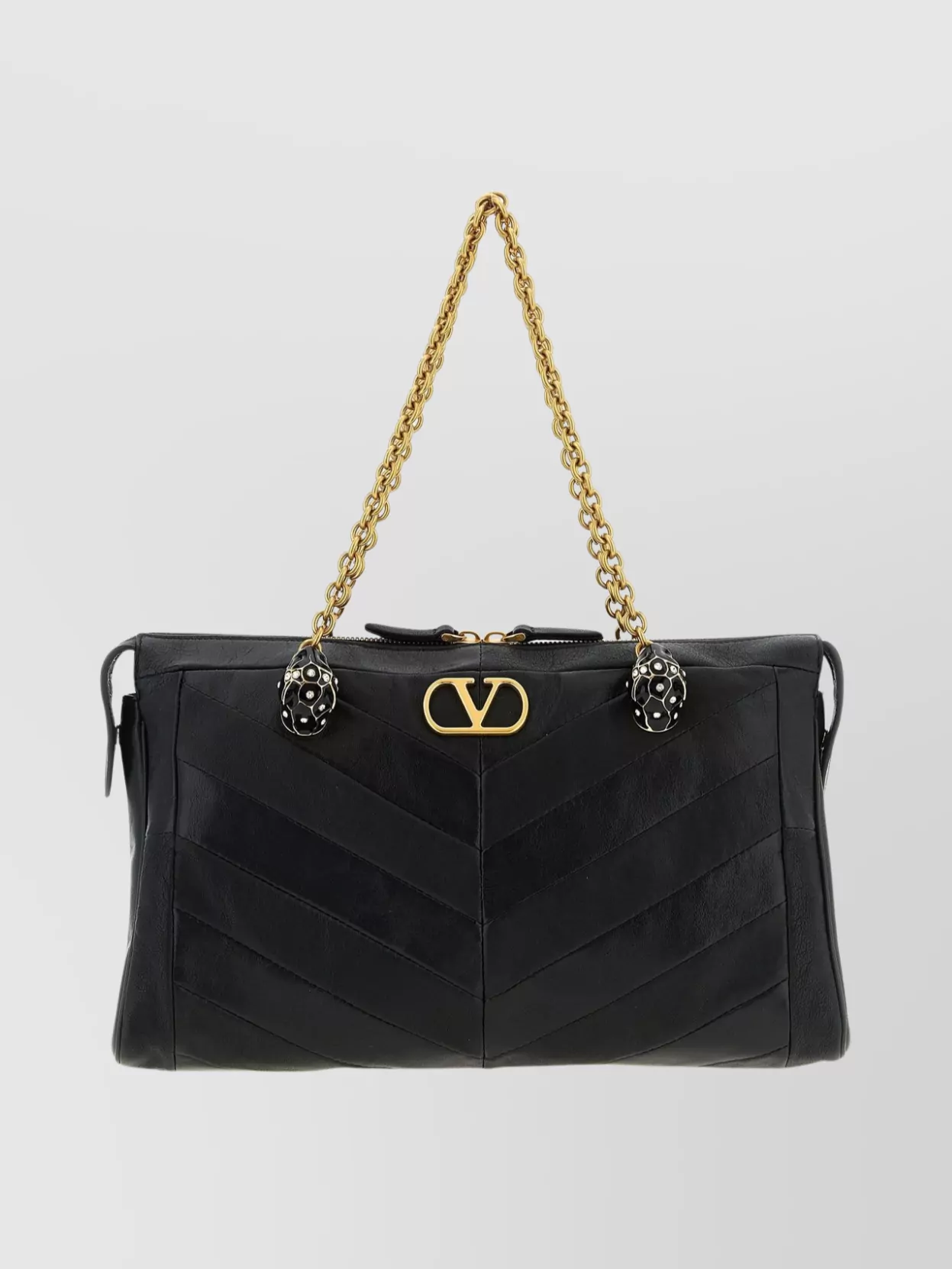
The Roman Stud is the most interesting of the group, because it has yet to disappear completely. Nobody mistakes the design: chevron and rhombus quilting in nappa, tone-on-tone stitching, and maxi pyramid studs set into the quilt lines. Absent from the current filters yet still carrying live product pages, it is best explained by one observed example. Take a small Roman Stud Handle Bag in denim, 21 by 17 by 14 centimetres, with argyle quilting, antique-brass studs, a front twist-lock and rear magnetic closure, made in Italy — it was listed at 3,550 dollars, shown as a reserved product, not orderable. Visible, priced, described in detail and unavailable — that is a line mid-exit. In practice the secondary market is where a Roman Stud turns up, so treat the line as transitional.
One Stud: pared back to one gesture
The Roman Stud multiplies hardware; the One Stud cuts it back to one oversized stud, and that restraint remains the idea. The archive column is where it sits, as the current filters leave it out either. Through a third-party retailer rather than the house, a large One Stud tote in nappa appeared at about 1,695 dollars, which is a useful reminder that a live listing is not current production. Retailers can still hold stock a season beyond the line’s end and clear it at a price of their own choosing. On purpose, no launch year is stated: the dates doing the rounds for this model originate with a single unverified source, and a guess presented as fact helps nobody. Some buyers hunt for it precisely because the shape reads quieter than most Valentino bags.
Supervee: resale only, with thin trading
Sitting within the VLogo family, the Supervee uses the V emblem as the structural event on the front rather than a small badge. Set against the Roman Stud, it has no halfway status — it has gone from the collection entirely. A single pre-owned VLogo Supervee shoulder bag was observed at around 866 dollars, and figures like that get mistaken for the market rate. A single listing is no market rate. The next example, in a thinly traded style, may be hundreds of dollars either side of that, depending on condition, colour, finish and seller patience. Before committing, anyone hunting an archive valentino shoulder bag should watch several platforms for weeks and establish a range.
Escape: reported gone
A resale platform has reported the VLogo Escape tote discontinued outright, which makes it the least ambiguous of the five. There is no mistaking the construction: hammered and quilted leather, double top handles, a removable shoulder strap and gold-tone hardware, built as a working tote rather than an occasion piece. Practical bags get used rather than stored, which shows in what turns up second-hand. Anticipate more wear at the handle roots and base corners than on an evening style of the same age. Current VLogo Signature shopping bags were observed between 2,650 and 3,750 dollars, so as a discontinued valentino tote bag it is worth it only at a genuinely attractive price. Let condition rather than the model’s reputation guide the decision.
Stud Sign, and the ones at the margins
The Garavani Stud Sign is a named product, most visibly a Stud Sign VLogo leather shoulder bag, but it is not in the current filters. It sits in archive or clearing rather than active, surfacing sporadically at retailers working through remaining stock. Resale commentary names the Candystud repeatedly as a house classic, but it could not be verified as part of the current collection, which leaves it in the unresolved column. Capsules, regional exclusives and retailer stock smudge the line between current and archive, which makes ambiguity like this normal at the edges of a large catalogue. Anything missing from the brand’s own filters is best regarded as a secondary-market purchase, which is the honest position to take. Ask any seller who insists otherwise to show you where it sits in the current collection.
What the archive actually costs
Prices for these bags come from two different places, and mixing them up ends in bad decisions. The retailer, not any official valentino bag sale, prices leftover new stock, which can sit well above or below the pre-owned figure. Condition and completeness drive secondary-market pricing, and in thin markets it moves unpredictably from listing to listing. Retention is the single hard number available, and it flatters this group — Rebag’s figures put the Roman Stud Flap at 58 percent of original retail, the strongest result in the range, against a house average of 41 percent for Valentino handbags in 2023. Secondary prices can drop, so treat this as observed market behaviour rather than a promise. Below, the table lays out each line’s status alongside the figures observed for it.
| Line | Current status | Observed price |
|---|---|---|
| Roman Stud | Phasing out; absent from the filters while pages persist | Denim Handle Bag $3,550, reserved and not orderable; flap style 58% retention |
| One Stud | Archive; gone from the current filters | About $1,695 for a large nappa tote at a third-party retailer |
| Supervee | Secondary market only | VLogo shoulder bag about $866 pre-owned |
| Escape | Reported discontinued by a resale platform | Current price unverified |
| Stud Sign | Run-out; absent from the filters | No confirmed current price |
Buying an archive bag and not regretting it
Before anything else, establish which company made the bag: Mario Valentino S.p.A. is a separate and unrelated business whose products also sell under a Valentino name. On a bag from the luxury house, an interior tag carries VALENTINO and GARAVANI in capitals with MADE IN ITALY, sewn on all four sides, evenly stamped and unsmudged. Most bags carry a serial number on a tag inside an interior pocket, though some do not, older models may carry none, and a missing number does not make a bag fake. Anyone claiming to read a manufacturing date from the numbers is making it up, because there is no date-code system to decode. Archive pieces deserve a look at stud seating, plating wear at the base corners, the action of any twist-lock and whether the lining has been cleaned or replaced. Photographs of the tag, base, hardware underside and strap attachments are non-negotiable before you pay.
What a disappearing line really means
None of the above turns an archive valentino bag into a worse object than it was last season. A bag whose motif no longer suits the current direction is still beautifully made, with the Italian construction it had — the cut was commercial. No new colours or seasonal materials, no guaranteed boutique repairs indefinitely and a slow drift in how recognisable the design feels — the practical effects really are narrow. An archive valentino garavani bag, on the other hand, is usually cheaper than its current-collection equivalent and is far less common on the street. The Roman Stud flap is the standout performer among these lines for anyone who cares about resale strength. Want the bag for its own sake? Then buy the best condition you can find from a seller who shows you everything and ignore what the filters say.


